
It was dreary all morning, the sky flat and blank like printer paper, and I would have waxed poetic about that as an omen for the summer to come.
The sun has begun to shine.
The sunglasses I ordered came in, teashades with little round lenses: one set gold, the other green. It’s nice to finally have some again, especially ones that flatter my face so well. I’m wearing the green because it matches my current favorite sweater.
Appendix: What’s In A Name?
In the beginning was the Word, and the Word was with God, and the Word was God.
John 1:1
Which is to say, with tremendous pretension, that you can get the “vibe” of a counterpart culture by the names they use. These broad guidelines should be applicable for the campaign I’m currently running in the Duskward Marches during the 23rd century [from Talahrius].
- Prymir-Gherdunnic names tend to be vaguely Greco-Roman: the Prymirans of Southhand tend towards the Hellenic, while the Gherdunnics of Northhand tend towards the Latinate. Most people have at least two given names/praenomina: a personal name (used among close friends and family) and a public name (used among strangers or acquaintances), in that order. Regarding surnames, clan names (nomen gentilicium) are patrilineal and rarely used beyond the nobility, although epithets (cognomena) are commonplace and sometimes become informal family names. The full formula is as such: [Personal Name(s)][Public Name(s)][Gens Name (if applicable)][Family Byname (if applicable)][Individual Byname(s)]
- The personal/public name distinction is very old, tracing back to when the proto-Gherdunnic peoples were enslaved by the Fahryliac Elves. The das-hu were counted among the beasts that perish, and were forbidden from speech and from having names. Out of the Shrouded Ones’ (pointed) earshot, however, secret tongues were spoken and hidden names were had. A personal name is something none under Heaven can take away.
- The in-universe monotheist philosopher/heretic Elkamelos of Keroi provides a worked example. His name at birth was “Diourios Elkamelos,” with Diourios being his personal name. He was known for most of his adult life as “[D.] Elkamelos Perissothenes” (Elkamelos of Abundant Strength) on account of being an absolute unit.
- The “D.” is a pragmatic translation of the formal practice of putting the first syllable of a personal name in front of the public name (e.g. on census records). The Talahrian script is an alpha-syllabary, à la Hangul.
- If a random name is needed or desired, the d100 lists of Infernal names in XGTE are useful (roll twice).
- Heidric names tend to be vaguely Germanic, with “civilized” Heidrics (influenced by centuries of Gherdunnic suzerainty) tending towards Anglo-Saxon influences and “barbarian” Heidrics towards Old Norse. Heidric given names are usually dithematic, consisting of two elements (often virtues, as understood by the sea-reavers anyway). The Northmen traditionally trace kinship through the mother’s line, so matronyms are common, but in recent decades patronyms have begun to be used, particularly in mixed Heidric-Gherdunnic areas like coastal Korvazthung north of the highlands. As with Gherdunnics, bynames and epithets are ubiquitous. The traditional formula is [Given Name][Matronym][Byname(s)]
- As an example of these shifts, the most famous Heidric raider of the age so far, self-proclaimed “King of Gherdun” (currently M.I.A.) Evander Alvarsson Redbeard bore a Gherdunnic given name and his father’s name.
- Thargric names are used among the mountain holds of Thagruun, and are vaguely Uralic, sometimes. If inspiration is needed, raiding the Kalevala might be helpful, but it’s good enough to base dwarvish names on vibes alone. Full Thargric names include patronyms and matronyms, plus dithematic clan names (one’s own kin being one’s father’s), and possibly epithets. A translated example including the names of parents and grandparents might be: “Trobate Stormfell the Younger, son of Alberich Stormfell (son of Trobate Stormfell the Elder & Bradewynn Blackbane) & Sormo Thundertongue (daughter of Cerol Thundertongue & Magnar Trimbreaker).” The formula is [Given Name][Clan Name][Byname(s)][Father’s Names][Paternal Grandfather’s Names][Paternal Grandmother’s Names][Mother’s Names][Maternal Grandfather’s Names][Maternal Grandmother’s Names], with great-grandparents (and earlier) being added, if notable, according to the same pattern. When dealing with outsiders, a single patronym might be used for simplicity’s sake (e.g. Trobate Stormfell the Younger Alberichsson).
- Under the Old Empire, the dwarvish population of the continent was reasonably well assimilated into the broader “Gherdunnic” framework, and had been for centuries, with their ancestors’ magma forges and mighty fortresses growing cold and empty; the cult of Ptah is sometimes said to have its origins among said dwarves. About half a century ago, ships bearing exiles from the distant east, from the lands of Thumyr in the “spine of the world”, arrived and began a campaign of colonization among the Jagged Isles and Central Ranges, claiming the abandoned holds for their own and offering dwarves refuge from the Empire’s collapse to rapidly bolster their ranks.
- The nearest Thargric settlement to the Pentapolis is Irondelve, a small minehead with a population of about fifty-something. The local clans are the Brightaxes, the Hardfists, and the Mugfists.
- Elvish names are tricky because though they once ruled the world, they’re few and far between nowadays, at least Around Here. Around Here, elvish names are vaguely Celtic nowadays, and some can sound quite modern to our ears, such as “Steve” [Steaphan] or “Keith.” A “complete” elvish name formula might be [Clan Name][Family Name][Byname][Given Name], with dithematic epithets and clan/family traced matrilineally. A worked example from a recent session might be “Wa Sakhe Moloch Keith,” being Keith of the family Moloch of the clan Wa Sakhe, sans epithets.
- As the charming name “Moloch” might suggest, the ancient Fahryliac civilization had quite different naming conventions, vestiges of which survive in the continent’s extant elf populations. The ruling battlemage caste were mononymic at birth, since shatra youths were raised by the state, although they would accumulate a bevy of fearsome epithets over their eternal lives. The naming convention above has its roots among the vishas, the [theoretically] free commoner castes of skilled artisans, administrators, merchants, and smallholders who formed the bulk of the Aryashanahac’s non-enslaved population. On the whole, Fahryliac names were vaguely similar, but not quite, to those of Greater Iran or the Indo-Persian world more broadly.
- For random names of Fahryliac origin, maybe roll on the d100 tables of Dragonborn names in XGTE?
- Around Here, in the large wood elf encampment of Dryador (pop. 500) the two largest clans are the Wa Sakhe and the Khagoi, who have been feuding for so long that the reasons are thoroughly muddled to outsiders. Possibly related to disputes about the proper veneration of Apollo and Artemis, or their elvish aspects anyway.
- As the charming name “Moloch” might suggest, the ancient Fahryliac civilization had quite different naming conventions, vestiges of which survive in the continent’s extant elf populations. The ruling battlemage caste were mononymic at birth, since shatra youths were raised by the state, although they would accumulate a bevy of fearsome epithets over their eternal lives. The naming convention above has its roots among the vishas, the [theoretically] free commoner castes of skilled artisans, administrators, merchants, and smallholders who formed the bulk of the Aryashanahac’s non-enslaved population. On the whole, Fahryliac names were vaguely similar, but not quite, to those of Greater Iran or the Indo-Persian world more broadly.
Appendix: Mind On My Money, Money On My Mind
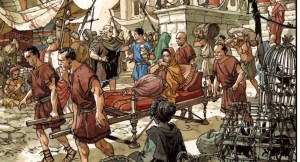
Most people Around Here don’t use coin. Tenant farmers pay their lords in produce and labor, and trade favors amongst themselves (“I give [now] so you give [later]”). Beyond the Pentapolis, the Duskmarch is mostly untamed wilderness, abandoned by what passes for civilization (and economics) in these times. The Old Empire had a cash economy, based around precious metals. Briefly, the Late Imperial system of coinage was as follows:
The most valuable coin in regular use was the gold aureus (plural aurei), although the previous sentence takes the Radiant Throne at its (worthless) word. The Empire’s economic woes resulted in the “aureus” being debased with silver (at best) to the point it was an electrum piece. From this debasement comes the common name for the late imperial aureus: the hyperpyron (plural hyperpyra) from the Prymir euphemism “super-refined”. The electrum hyperpyron is the most valuable coin a commoner in the Duskmarch might expect to see with any degree of regularity (and even then, not often). A single hyperpyron can get a pound of copper or a square yard of cotton cloth. Aurei of actual gold are rare in daily life, but can be found in the pockets of traders and raiders alike; a single aureus (two hyperpyra) can get a pound of ginger or a goat, or cover a day of modest expenses.
The most valuable coin a commoner might expect to regularly use is the silver argenteus (plural argentei). The argenteus was one of the later coins to begin being minted, after the denarius (see below) stopped being worth its face value. A single argenteus can buy a pound of iron or a square yard of canvas, and it costs an argenteus a day to maintain a squalid lifestyle. A somewhat common practice among the sea-reavers of Heidricia and the horse clans/goblins of the Orowich steppe is to chop silver items into coin as needed, this “hacksilver” can vary significantly in size but is roughly comparable to the argenteus (1/3rd of an ounce).
The denarius (plural denarii) is struck from copper or other base metals. In ancient times the denarius was a silver coin, but centuries of debasement resulted in it containing less and less silver until they had to start minting the argenteus to compensate. Denarii are ubiquitous, even among those who don’t regularly handle cash. A single denarius can buy a pound of unmilled rice, milled costs two.
If real world comparisons are needed, the denarius is akin to a $1 bill, the argenteus $10, the hyperpyron $50, and the aureus (a pure one) $100.
Platinum is sometimes called “white gold” or “dwarvish silver”, and platinum coins are quite rare Around Here, although in recent years they’ve become slightly more common (though not by much). 1/3rd of an ounce in “white gold” can generally be exchanged for two pounds of silver (or 100 argentei), which could buy a pound of silk or a dairy cow, or allow one to live like a king/queen (well, a lord/lady) for a day. A pound of “white gold” is worth about a hundred pounds of silver (5,000 argentei!), or almost a year and a half’s daily expenses, living modestly. Think coming into $50k in real life and you almost have the right idea.

